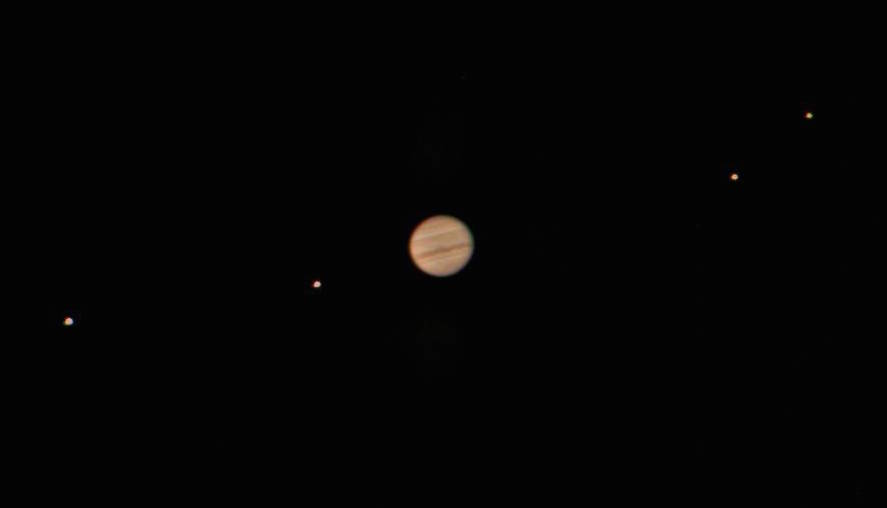
Jupiter is the fifth planet from the Sun and the largest in the Solar System. It is a gas giant with a mass more than two and a half times that of all the other planets in the Solar System combined, but slightly less than one-thousandth the mass of the Sun. Jupiter is the third brightest natural object in the Earth‘s night sky after the Moon and Venus. People have been observing it since prehistoric times; it was named after the Roman god Jupiter, the king of the gods, because of its observed size. At least 97 moons orbit the planet; the four largest moons—Io, Europa, Ganymede, and Callisto—orbit within the magnetosphere and are visible with common binoculars. Ganymede, the largest of the four, is larger than the planet Mercury. Jupiter is surrounded by a faint system of planetary rings. The Great Red Spot is a persistent, high-pressure region in the atmosphere of the planet Jupiter, producing the largest anticyclonic storm in the Solar System. It is the most recognizable feature on Jupiter, owing to its red-orange color whose origin is still unknown. Located 22 degrees south of Jupiter’s equator, it produces wind-speeds up to 432 km/h (268 mph). It was first observed in September 1831, with 60 recorded observations between then and 1878, when continuous observations began.[1][2][3] A similar spot was observed from 1665 to 1713; if this is the same storm, it has existed for at least 361 years,[4][5]
Meade 16″ LX200, Baader UV/IR Cut filter, TeleVue 2X Barlow, ZWO ADC, ZWO ASI 174 Sharpcap Pro, Astrosurface and Photoshop 2/10/2026